Will retirement village life be right for you?

With the number of New Zealanders 75 years or older on the rise, more people are actively considering their options for retirement living.
Retirement villages are an increasingly popular choice with an estimated 56,000 New Zealanders living in a village at the end of 2024. The decision to move into a village is a big step, so how do you know if it will be right for you?
Key takeaways
- Retirement village living offers a low maintenance, low stress lifestyle.
- Social interaction and companionship are common reasons for moving into a village.
- Most villages have a range of onsite amenities and activities on offer.
- Many retirement villages provide residents with access to support and healthcare.
- Buying into a village requires an upfront capital outlay, which may not be affordable for some people.
- Housing in a retirement village is often dense, with neighbours close by.
- If care is required immediately, a retirement village may not be suitable.
- Downsizing and moving out of the family home can be a daunting prospect.
In 2025, Village Guide conducted a survey of Kiwi retirement village residents to find out what factors were important in making the decision to move into a village. Here’s what our survey revealed.
Four reasons why retirement living may be right for you
1. Low-maintenance lifestyle
The opportunity to simplify life and enjoy a low-maintenance lifestyle draws many people to retirement village living.
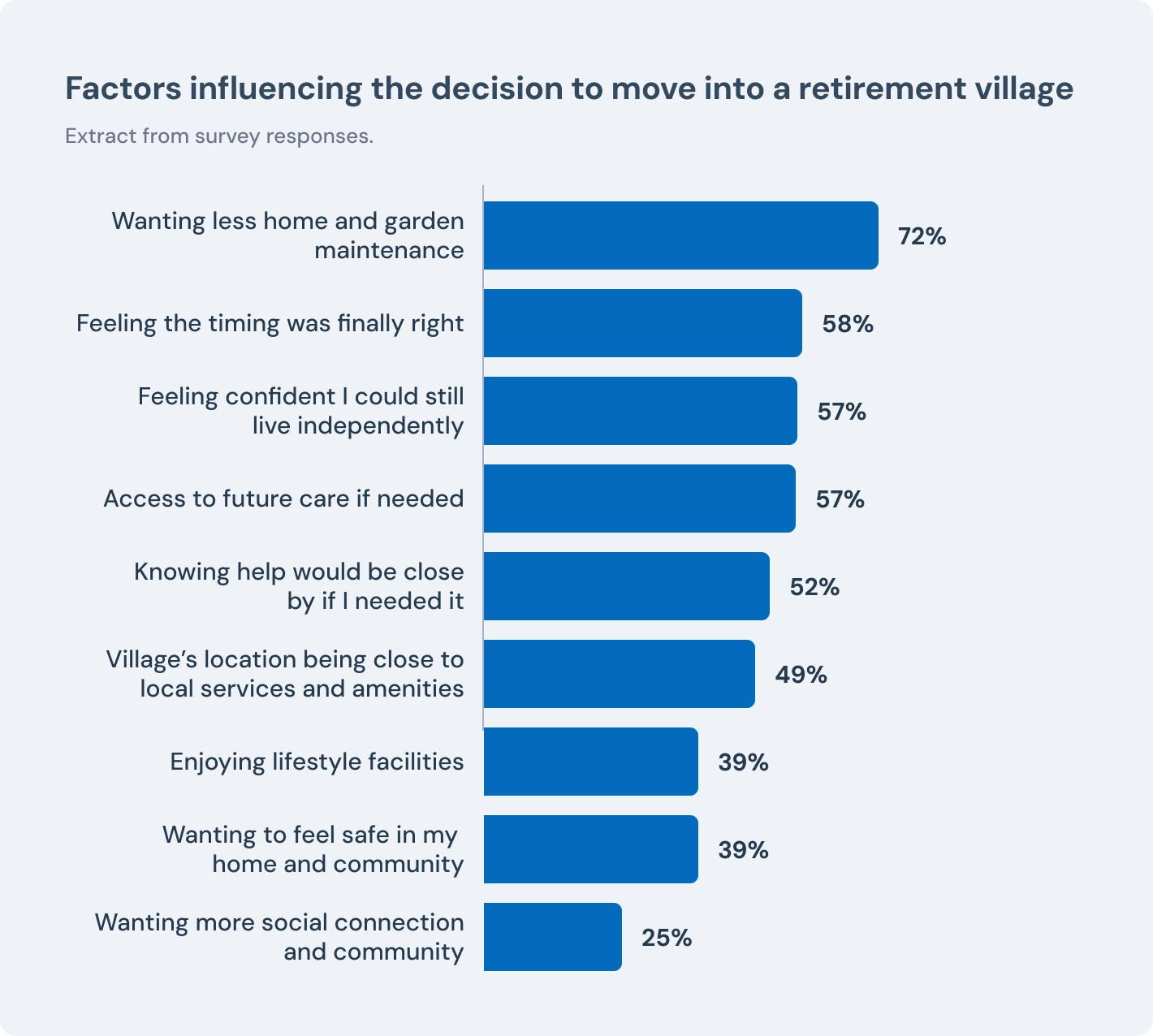
In Village Guide’s 2025 survey, 72% of residents surveyed cited a desire to reduce home and garden maintenance as the strongest motivating factor to move into a retirement village.
In a retirement village, the amount of time spent on home maintenance and tending to gardens and lawns is dramatically reduced. In most villages:
- The village operator looks after the maintenance of home exteriors, grounds, amenities and shared spaces.
- Homes are refurbished before the resident moves in.
- Many maintenance services, such as fixing a broken appliance or replacing a light bulb, can be arranged by simply calling the village office.
- As people get older, the prospect of organising and paying tradespeople to carry out maintenance jobs, or undertaking these jobs themselves, can become more tiresome. Retirement village living removes much of that stress.
2. Independent living—with a pathway to care
Retirement villages offer ‘independent living’ where residents operate much the same way they did before they moved into a village, enjoying the privacy of their own home and coming and going as they please.
Over half of survey respondents cited the ability to live independently, with additional support available, as important factors in their decision to move into a retirement village:
- Feeling confident I could still live independently (57%)
- Knowing help was on hand if needed (52%)
- Access to future care if needed (57%)
Many retirement villages offer a pathway to care when residents are no longer able to manage in their own apartment or villa. Around 65% of villages have an on-site care facility, which means residents don’t have to move out of the village when they go into care.* If a resident needs to move from independent living into care, their partner can remain close by in the village, which offers peace of mind for couples considering retirement village living.
*Subject to the availability of a place in the on-site care facility, at the time of the move into care.
Find out more: Transitioning to higher level care: what you need to know
Some villages also offer serviced apartments, where you can continue to look after yourself in your own home, but receive assistance such as meal preparation, laundry services, house cleaning and basic healthcare.
This is also known as assisted living, and is something of a middle ground between fully independent living and a care facility.
Find out more: Serviced apartments
3. Social connection
Many people choose to move into a retirement village because they are keen to live in a community of like-minded people their own age, where they can enjoy companionship and develop new friendships.
Social connection is essential for healthy ageing, and has been linked to improvements in both mental and physical health.
Village Guide’s 2025 survey revealed that ‘wanting more social connection’ was an important driver for 25% of respondents. After making the move, 23% found social connection to be a ‘surprising benefit’.
Most villages offer a wide range of organised activities, and many also have clubs or special interest groups, all of which help bring residents together. Every village is different but it’s not uncommon to find a wide variety of activities, such as arts and crafts sessions, woodworking, happy hours, movie and quiz nights, gardening groups and guest speakers.
Find out more: Twelve health benefits of moving into a retirement village
4. Easier to keep active and stimulated
The move into a retirement village is also attractive for older New Zealanders because it’s easier to remain active and engaged.
Some villages have fitness facilities, such as gyms or swimming pools, and offer organised exercise classes to help residents stay active. Many have bowls and pétanque for those who enjoy outdoor pursuits. And shared spaces like lounges, cafes, bars and libraries provide opportunities to get to know neighbours in a relaxed, congenial environment.
Enjoying lifestyle facilities was an important driver for 39% of residents surveyed, while 49% cited proximity to local services and amenities.
Villages typically provide communal transport to support access to shopping and entertainment, even if residents no longer own a car or if the village isn’t close to regular public transport.
Four reasons why retirement living may not be right for you
1. Financial outlay
Moving into a retirement village is a property transaction which usually involves the purchase of an occupancy right to live in a dwelling.
Villages in New Zealand don’t typically offer rental arrangements. This means that a capital outlay is required to buy into a village, rather than paying a weekly rental amount.
The national median advertised price for retirement village homes listed on Village Guide across New Zealand reached $690,000 in the six months to June 2026, however there were some large regional differences. Auckland’s median advertised price was $795,000 for the period, Tauranga $711,000; Christchurch $654,500; and Wellington $812,000.
Unfortunately, not everyone has the available funds, even after the sale of the family home, to make the move into a village.
In addition to the capital outlay, most villages charge weekly or periodic fees, as well as a Deferred Management Fee when a resident leaves the village. Fee structures vary from village to village, so it’s important to consider these carefully when making your decision.
Find out more:
Search for retirement village dwellings by price
The costs of living in a retirement village
2. Proximity to neighbours
Retirement living is a form of communal living, where residents live alongside others in an established community with shared spaces.
By its nature, this style of living tends to involve denser housing types—such as villas or apartments—compared to what would be found in many New Zealand suburbs.
For some residents, this style of living leads to a greater sense of connection and safety, important factors for many of Village Guide's survey respondents.
However, living close to neighbours isn’t for everyone, especially those who are used to living on a large block of land, or those who prefer to keep to themselves.
3. Immediate care needs
Retirement village homes are designed for independent living, and while they often include features that make them suitable for older New Zealanders, they are not designed for people who require full time care.
If you prefer to live independently but need some support with everyday tasks, assisted living could be an option. Residents live in a serviced apartment and can get help with everyday tasks such as cooking and cleaning, personal care, or everyday medical needs.
Find out more: Serviced apartments
If you or your partner can no longer manage independently and full-time care is required, you will need to look at care facilities. Not all care facilities cater for every level of care, so it’s best to start by having your care needs assessed.
Find out more: Rest home care
4. The stress of moving
The thought of packing up and moving house, including making decisions about what to do with a lifetime’s worth of belongings, can be overwhelming.
Others find the downsizing process liberating, prefer to be in control of sorting out their possessions, or feel a sense of relief after shedding things they no longer use or need.
Whether or not you decide to move into a retirement village, the good news is that there are downsizing and moving services specifically designed to help take the stress and effort out of this process.
Making the decision
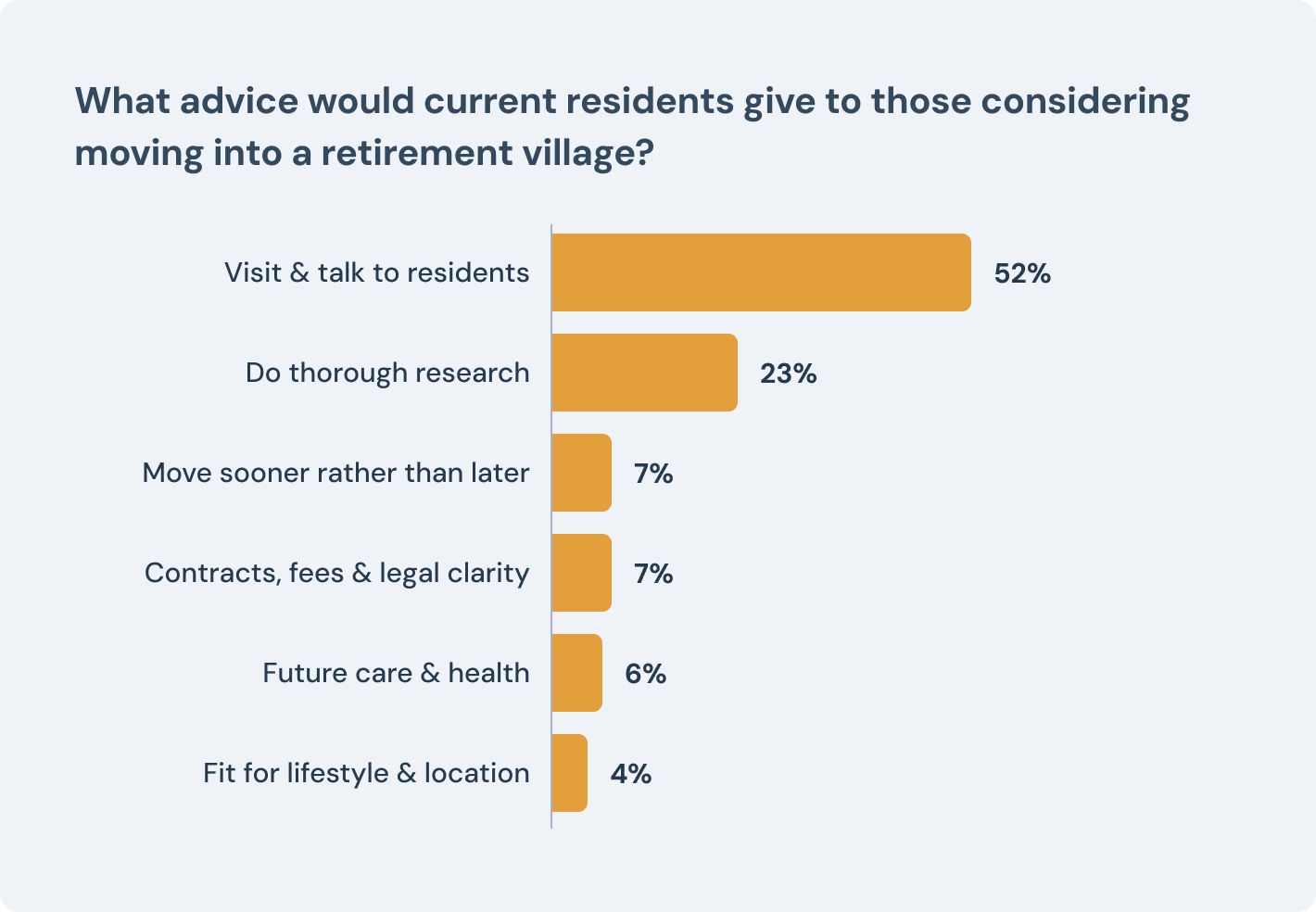
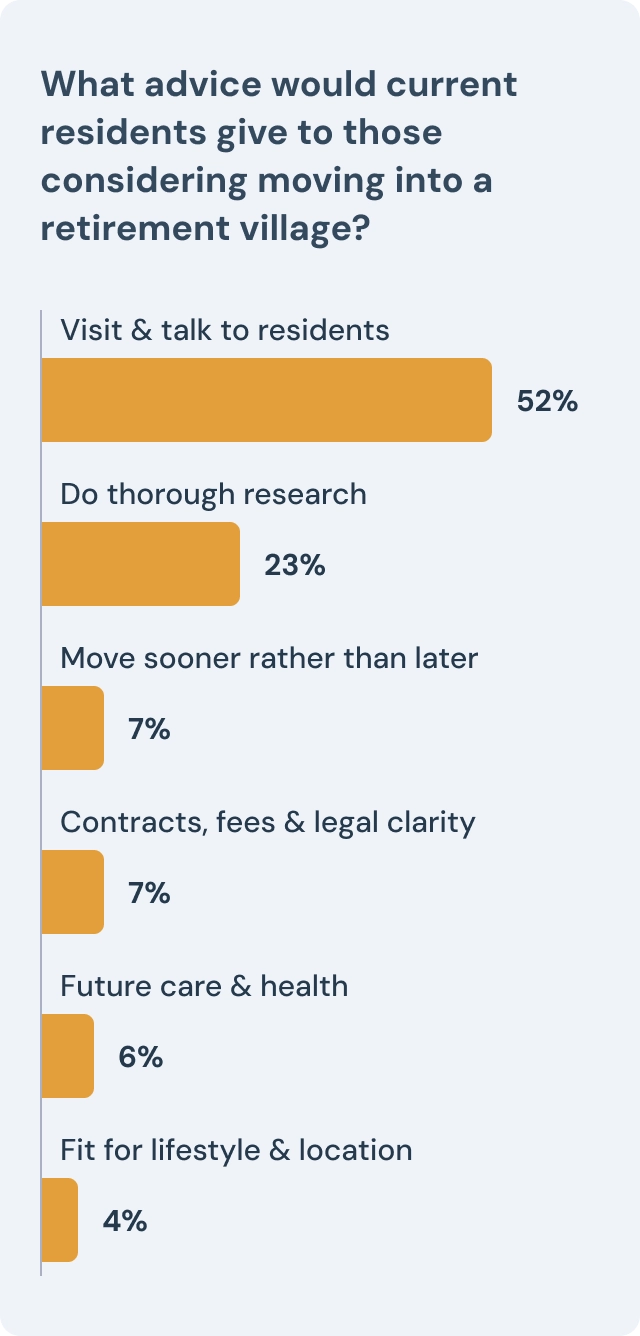
When asked what advice they would give to people considering the retirement village decision, 52% of Village Guide’s respondents recommended visiting the village and talking to residents:
Visit often to get the feel of the village and talk to as many residents as possible.”
Visit at least 4 villages. Talk with existing residents and involve your family in the decision.”
One of the best ways to determine if retirement village living might be for you is to attend some open days. This will give you an opportunity to experience the village culture, meet residents, view the facilities and learn more about what each village has to offer.
Keep an eye on the Village Guide Open Day page to find upcoming open days at a village near you.
Open days are also good opportunities to learn about how each village operates. 23% of Village Guide’s survey respondents recommended that those considering the retirement village decision research their options thoroughly:
Look at all the info you can about village life and use the Village Guide.”
Do your research, find out all you can and don’t just listen to one or two people’s versions or ideas. If you have questions, just ask.”
A great place to head is Village Guide’s Resource Centre where you’ll find a wealth of information to help you decide if retirement village life is right for you.
Finally, if you are searching for a village and have an idea of where you want to live, try out Village Guide’s search tools. You can find retirement villages and homes for sale based on location and compare different villages in your area.
Frequently asked questions
Common benefits include less home and garden maintenance, more opportunities for social connection, access to activities and facilities, and the availability of additional support or care if your needs change.
Retirement village living requires an upfront financial commitment. Downsizing can also be stressful, and village homes are generally not suitable for people who already require full-time care.
Many villages offer home support services to residents living independently, either through the village or an external provider. Some also offer serviced apartments for people who need help with daily tasks. Around 65% of villages have an on-site care facility for residents who are assessed as needing permanent residential care, although a place may not always be available when needed.
Prices vary considerably by location, village and type of home. The national median advertised price for retirement village homes listed on Village Guide was $690,000 in the six months to June 2026. You will also need to understand the village's ongoing fees and the costs that apply when you leave.
Visit several villages, speak with current residents and compare the financial terms, facilities, location and care options. Consider how each village would suit both your current lifestyle and your likely future needs.