What is a Retirement Village Disclosure Statement in New Zealand?

A retirement village disclosure statement is a legally required document in New Zealand that outlines how a retirement village operates. It explains ownership, fees, services, repayment terms, and development plans so prospective residents can make an informed decision before signing an Occupation Right Agreement.
Why Disclosure Statements Matter
Before you sign an Occupation Right Agreement, you must receive a current disclosure statement.
Disclosure statements are required under the Retirement Villages Act 2003 and must comply with the Retirement Villages (General) Regulations 2006.
They work alongside the Code of Practice and the Code of Residents’ Rights to promote transparency and consumer protection.
Every registered retirement village in New Zealand must provide a current disclosure statement to prospective residents.
What the disclosure statement must include
By law, a retirement village disclosure statement must set out key information about the village, including:
- Who owns the village and who is responsible for managing it
- The services and facilities available to residents
- How costs are structured, including the capital sum payable on entry, ongoing village fees, deferred management fees, and how exit deductions are calculated
- Whether the village is complete or still being developed
- When your capital sum will be repaid after you leave
- What happens if you move to another home or into a higher level of care within the village
- The role of the statutory supervisor and how residents’ interests are protected
The purpose is to give prospective residents a clear understanding of both the operational structure and the financial framework before signing an Occupation Right Agreement.
Comparing different disclosure statements
Disclosure statements are detailed documents and they can vary significantly between villages. While the law sets minimum content requirements, structure and detail differ between operators.
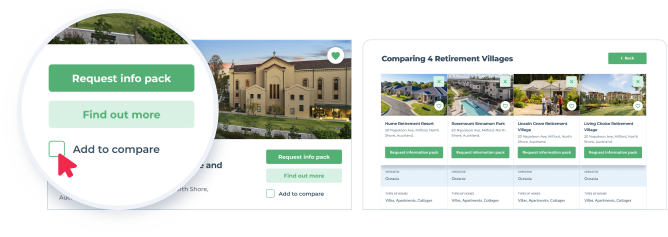
Village Guide’s comparison pages summarise key information from disclosure statements to help you compare villages side by side.
Compare villages side by side
See care pathways, home types, cost information, and other important details.
 Start browsing villages
For selected villages, we also publish a Village Summary - a four-page document that brings together the most important details from the disclosure statement in a consistent, easy-to-read format.
Frequently asked questions
When should I receive a disclosure statement?
The village sales manager will usually provide you with a disclosure statement when you visit a village, or you can ask for one to be emailed to you. The Government has announced reforms to the Retirement Villages Act that will require operators to publish the most recent disclosure statement on their website. These changes were outlined in a Cabinet paper released by the Ministry of Housing and Urban Development in December 2025 and are expected to be implemented through amendments to the legislation.
Is the disclosure statement legally binding?
The disclosure statement itself is not the contract, but it must accurately reflect what is set out in the Occupation Right Agreement.
Can a disclosure statement change over time?
Yes. Disclosure statements are updated when there are changes to fees, facilities, ownership, or future development plans. Always make sure you are reviewing the most recent version.
Does every village use the same format?
No. While the law sets out what must be included, the structure and level of detail can vary between operators, which is why comparisons can be tricky.
What should I pay closest attention to?
Focus on fees and how they may change over time, what happens when you leave the village, repayment timeframes, and which services are included versus optional extras. Village Guide also suggests looking at what homes have sold in the past 12 months and how long they took to sell, as this can provide useful context.
How does Village Guide use disclosure statements?
Village Guide reviews disclosure statements to extract and summarise key information. This allows us to present consistent comparisons across villages while remaining independent.
Independent advice Is important
This article provides general information only and does not constitute legal or financial advice. You should seek independent legal and financial advice before signing an Occupation Right Agreement.